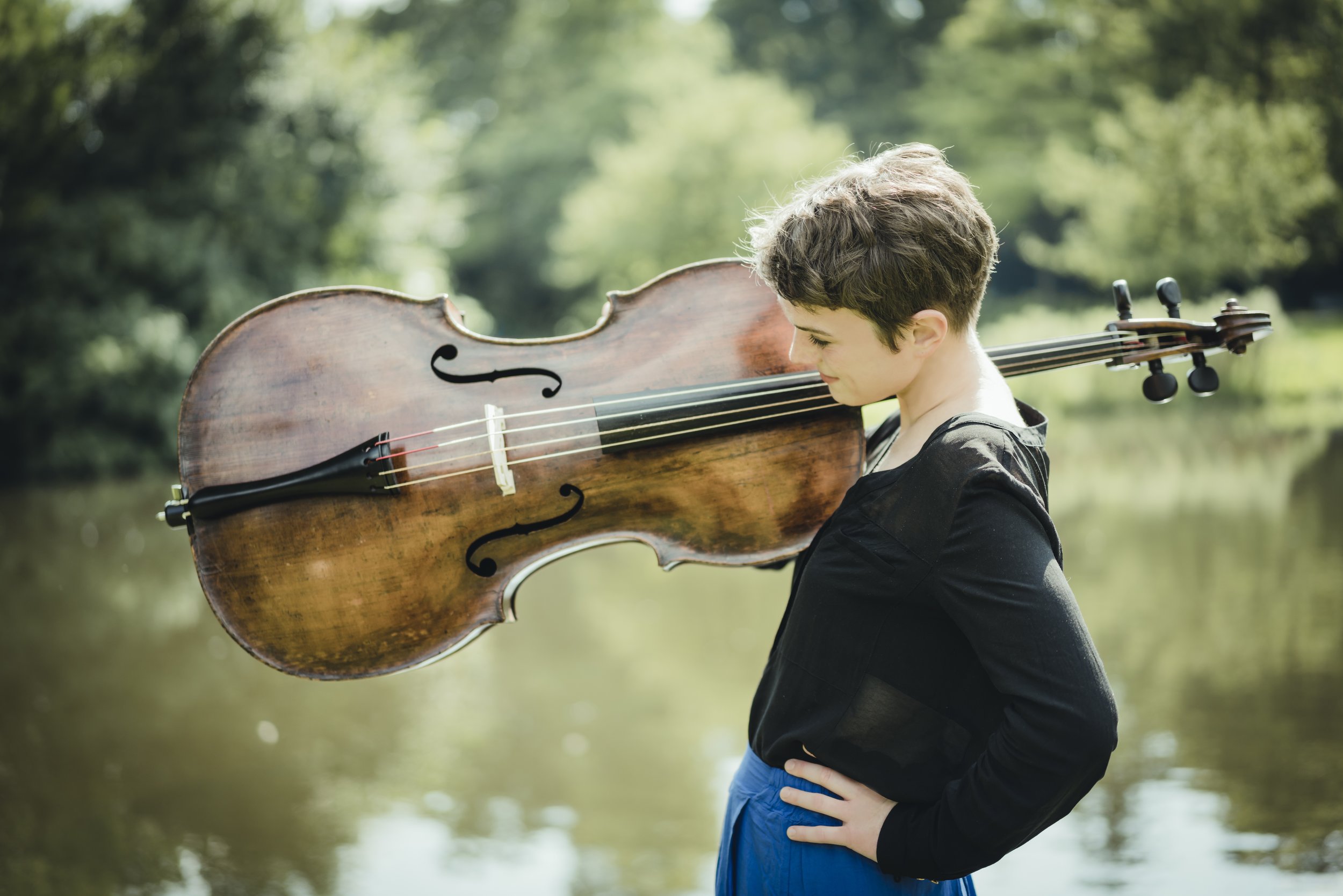
Biography
Octavie Dostaler-Lalonde is an internationally active historical cellist, soloist, and researcher whose work spans repertoire from the late 17th to the early 20th centuries. Her artistic practice brings together historically informed performance, leadership, and research, allowing her to move fluently between Baroque, Classical, Romantic, and early modern repertoires. She is Professor of Historical Cello at the Conservatorium van Amsterdam.
Initially trained as a modern cellist at the Conservatoire de Musique de Montréal with Denis Brott and Carole Sirois, she received the Prix avec Grande Distinction in 2011. Drawn early to questions of performance practice, she continued her studies on baroque cello with Susie Napper in Montreal and later with Viola de Hoog in Amsterdam, where she developed an approach grounded in historical sources, period instruments, and stylistically specific techniques.
A prize winner at leading international competitions—including the Concours Corneille (France), the Early Music Competition in Yamanashi (Japan), and the Graun Brothers Award—Octavie has held principal cello positions with ensembles such as the Nederlandse Bachvereniging, Il Gardellino, Vox Luminis, La Sfera Armoniosa, and Ensemble Alia Mens. As an orchestral musician, she collaborates regularly with major period-instrument orchestras including the Orchestra of the 18th Century, the Orchestra of the Age of Enlightenment, the Orchestre Révolutionnaire et Romantique, Utopia, and the Montreal Symphony Orchestra.
She appears frequently as a soloist and chamber musician at major international festivals and venues, including Festival Oude Muziek Utrecht, Grachtenfestival, Folle Journée Tokyo, Festival Royaumont, MA Brugge, Bozar, AMUZ, and Festival Montréal Baroque. A central artistic partnership in her work is with historical keyboardist Artem Belogurov; together they co-direct the early music ensemble Postscript, dedicated to historically informed approaches to Classical and Romantic repertoire.
Octavie has recorded more than twenty albums for labels such as Alpha Classics, Challenge Classics, Pentatone, Ricercar, Passacaille, Brilliant Classics, and Paraty. Her debut solo recording From Mannheim to Berlin (Challenge Classics) received a Gramophone Editor’s Choice, five stars from De Standaard, a BBC recommendation, and was long-listed for the Preis der Deutschen Schallplattenkritik.
Alongside her performance activity, Octavie is deeply engaged in artistic research. She was co-director of Romberg Dagen, a festival dedicated to the music and legacy of Bernhard Romberg, and is the co-creator of Romantic Lab, a research platform exploring late 19th- and early 20th-century performance practice through the systematic imitation of early recordings. Her artistic and research projects have been supported by the Canada Council for the Arts, Fonds Podiumkunsten, and the Amsterdam Fonds voor de Kunst.
She plays a Thomas Dodd cello (c.1800), on loan from the Nationaal Muziekinstrumenten Fonds of the Netherlands, as well as her own ca.1700 baroque cello by Johann Michael Alban.